
Meals taken in a hurry, homework piling up, screens capturing everyone’s attention in their own corner: family life often resembles an obstacle course. Cultivating harmony in the family on a daily basis doesn’t require reinventing everything, but rather adjusting a few concrete habits so that each member finds their place.
Online Family Mediation: An Underestimated Tool for Diffusing Conflicts
Have you ever noticed that a minor disagreement between parent and child can poison an entire evening? Tension builds, no one backs down, and the rest of the family suffers. Since mid-2025, associations of single parents have reported a decrease in family conflicts thanks to online family mediation workshops.
The principle is simple. A professional mediator leads a short video conference, often lasting an hour, where each member expresses their feelings without interruption. This approach works particularly well for blended families, where tensions related to each person’s roles are common.
The advantage of the digital format is accessibility. No need for travel or additional childcare. Complementary resources on family life are available at https://www.happy-family.org/ to extend this approach into daily life.
Extended Meal Rituals: What Mediterranean Families Do Differently
According to the OECD, Mediterranean families show superior emotional resilience compared to more individualistic Northern European models. The main factor identified: collective rituals, primarily extended meals.
No need to cook for three hours to replicate this effect. What matters is the time spent at the table together, without screens, where conversation flows freely.
In practice, this can take several forms:
- A family dinner where everyone shares a positive moment from their day, even if brief, to establish a habit of shared gratitude
- A longer weekend meal than usual, with a dish prepared together, including by the children as soon as they can chop or mix
- A simple rule: phones stay in another room while eating, adults included
Sharing a meal without screens remains the most effective family ritual for maintaining regular communication. It costs nothing and requires no complex organization.
Single-Parent Family in the City: Adapting Family Harmony to Digital Isolation
For an urban single-parent family, family balance is built under different conditions. The parent manages the child’s emotions, daily routines, and their own fatigue alone, without immediate support at home.
Digital isolation exacerbates the situation. When the only social link is through a screen, the quality of parental presence deteriorates. The parent scrolls out of exhaustion, and the child mimics this behavior. Time spent together exists on paper but not in reality.
Some realistic adjustments can help break this cycle:
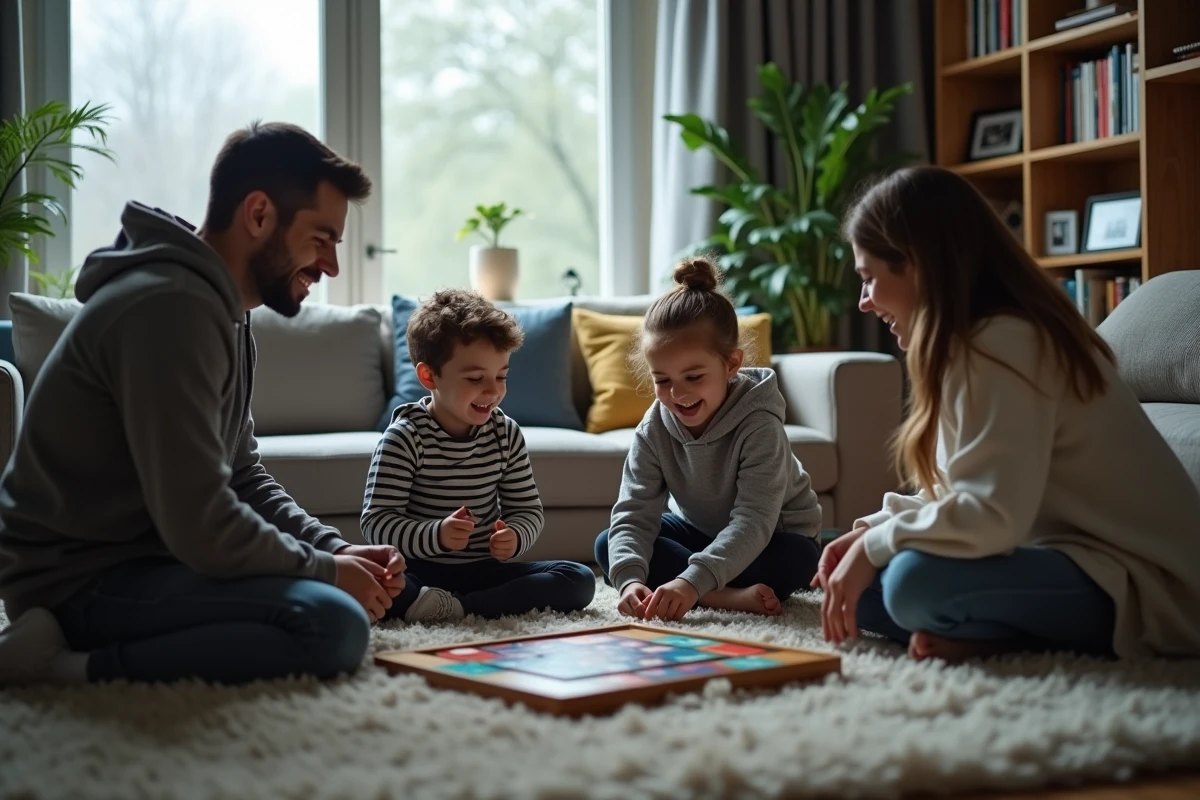
- Set a daily slot of twenty minutes without any connected devices, dedicated to a shared activity (board game, drawing, walk)
- Engage grandparents or a close relative for regular video calls with the child, which expands the emotional circle without travel
- Participate in an online family mediation workshop to express difficulties without guilt
The INSEE report from February 2026 also confirms a growing involvement of grandparents in the daily care of children, partly due to the shortage of childcare options. For a single-parent family, this intergenerational support changes the game.

Active Listening and Emotion Management in the Family: Moving Beyond Clichés
“Tell me about your day” almost never works with an eight-year-old. The question is too vague. Active listening in the family involves more precise techniques.
The first: ask closed questions to open the conversation. “Who did you sit next to in the cafeteria?” produces a factual answer, which naturally leads to a more personal story. The second: rephrase what the child just said before reacting. “If I understand correctly, you were upset because your friend changed the rules of the game?” This rephrasing shows that the parent has listened, not just heard.
For strong emotions, the technique of “naming to calm” also works for adults. When a family member is overwhelmed by frustration or sadness, simply naming the emotion reduces its intensity. Saying “I see that you’re disappointed” to a child, or “I’m tired and irritable tonight” to a partner, diffuses many conflicts before they escalate.
Family communication progresses through regularity, not intensity. Five minutes of real listening each day is worth more than a big monthly discussion.
A meal without a phone, an emotion named out loud, a time slot preserved to truly be together: these daily micro-adjustments build family harmony more surely than a grand educational project launched on a Sunday evening.