
Sporting consistency rarely relies on sheer willpower. Recent work in motivation psychology places self-compassion, that is, the ability to absorb a failed session without guilt, as a more reliable predictor of consistency than the rigid discipline advocated by most mainstream programs. Practicing sports daily requires less spectacular effort than well-thought-out behavioral architecture.
Light Periodization and Perceived Load: Structuring Without Rigidifying
Applying the same linear block each week is the primary factor for dropouts among uncoached practitioners. We recommend a simplified periodization over three to four weeks: two weeks of normal load, one week of moderate overload, and one week of active recovery.
This scheme, borrowed from structured physical preparation, avoids monotony without requiring complex planning. Overload does not mean doubling the volume, but increasing the perceived intensity (slower tempo on exercises, reduced rest periods, unilateral variations).
Active recovery protects against insidious overtraining that sets in among those who perform sessions at constant intensity for months. Fast walking, joint mobility, gentle yoga: the body recovers and motivation does not erode.
Specialized resources compile programs tailored to this type of progression; the Sportetica website for sports offers content organized by level and goal, making it easier to calibrate personal periodization.
Micro-Sessions and Exercise Snacks: What Research Validates
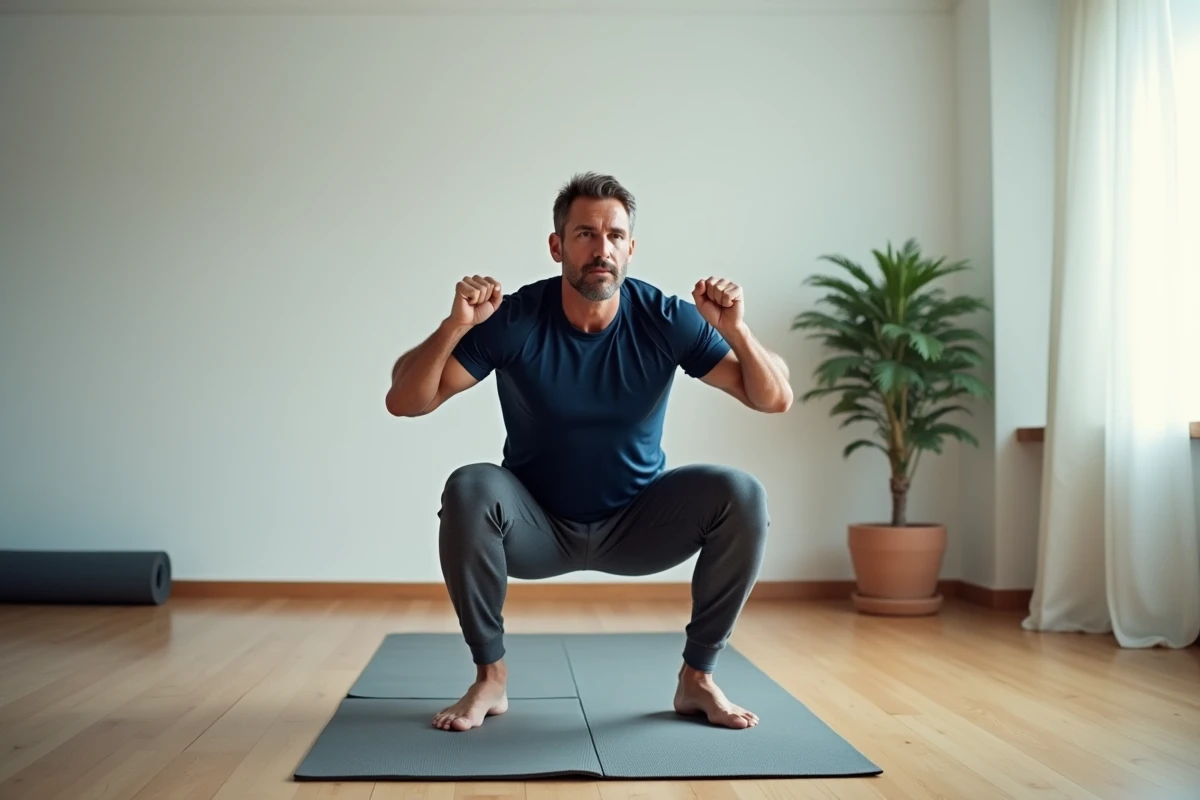
The American College of Sports Medicine recommends “exercise snacks,” blocks of five to ten minutes spread throughout the day, as a credible alternative to a continuous forty-five-minute session. This format is particularly suitable for sedentary individuals or those whose schedules make long sessions impractical.
Three micro-sessions of eight minutes are better than a failed forty-five-minute session. The cardiovascular and metabolic benefits are documented, and the effect on motivation is clear: the psychological entry barrier disappears when the announced effort fits into a coffee break.
An exercise snack can take several forms:
- Going up and down stairs at a brisk pace for three to five minutes, ideally two to three times during the workday
- A series of squats, push-ups, and planks performed consecutively without rest, calibrated between five and eight minutes, doable in a closed office or small space
- Fast walking or walking uphill (treadmill or outdoors) for ten minutes, integrated into the commute or lunch break
Since the update of WHO recommendations in 2020, Public Health France emphasizes the principle that “every activity counts.” Climbing stairs, walking while on the phone, or doing active housework are now explicitly presented as useful daily sports for health.
Self-Compassion and Motivation: Going Beyond the Disciplinary Model
Research published between 2022 and 2024 in motivation psychology shows that mere rigor is not enough to maintain regular practice. Self-compassion is a significant predictor of consistency over several months, sometimes surpassing perceived discipline.
In practice, this means that a practitioner who skips a session and resumes the next day without rumination maintains their routine better than one who feels guilty, compensates with a double session, and then abandons the following week. This mechanism is known as the “what-the-hell” effect: a transgression perceived as a failure triggers a global abandonment.
We observe that practitioners who endure over time rarely share a “disciplined warrior” profile. They rather share three characteristics:
- An explicit tolerance for deviations, integrated into their planning (one to two “skippable” sessions per month without readjusting the program)
- Process-oriented goals rather than outcome goals: “I will do three sessions this week” rather than “I will lose two kilos this month”
- A minimalist tracking system, such as a notebook or simple app, without social ranking or competitive leaderboard
This last point aligns with a trend documented since 2023: public rankings and leaderboards demotivate an increasing number of users of sports apps. Discreet features (personal history, private streaks, adaptive reminders) show better results in long-term adherence.

Daily Sports Routine: Behavioral Anchoring Rather Than Scheduling
Setting a session at 6 PM on Tuesday is a schedule. Associating training with a contextual trigger (coming home from work, putting down your bag, putting on your shoes) is an anchor. The difference is substantial: the schedule depends on punctuality, the anchor depends on a gesture you already do.
Behavioral anchoring reduces the decision-making load associated with each session. The fewer decisions required to start training, the more likely you are to do it. Preparing your outfit the night before, leaving your yoga mat unfolded, choosing your program in advance: every friction removed counts.
This principle also works for exercises integrated into daily life. Associating stair climbing with returning from a break, planking at the end of brushing your teeth, or doing squats while waiting for the kettle transforms idle moments into micro-workouts without requiring additional willpower.
Flexible periodization, micro-sessions, and contextual triggers share the same principle: reducing the entry cost of each workout. Self-compassion in the face of missed sessions does the rest by preventing the first deviation from becoming a permanent abandonment.