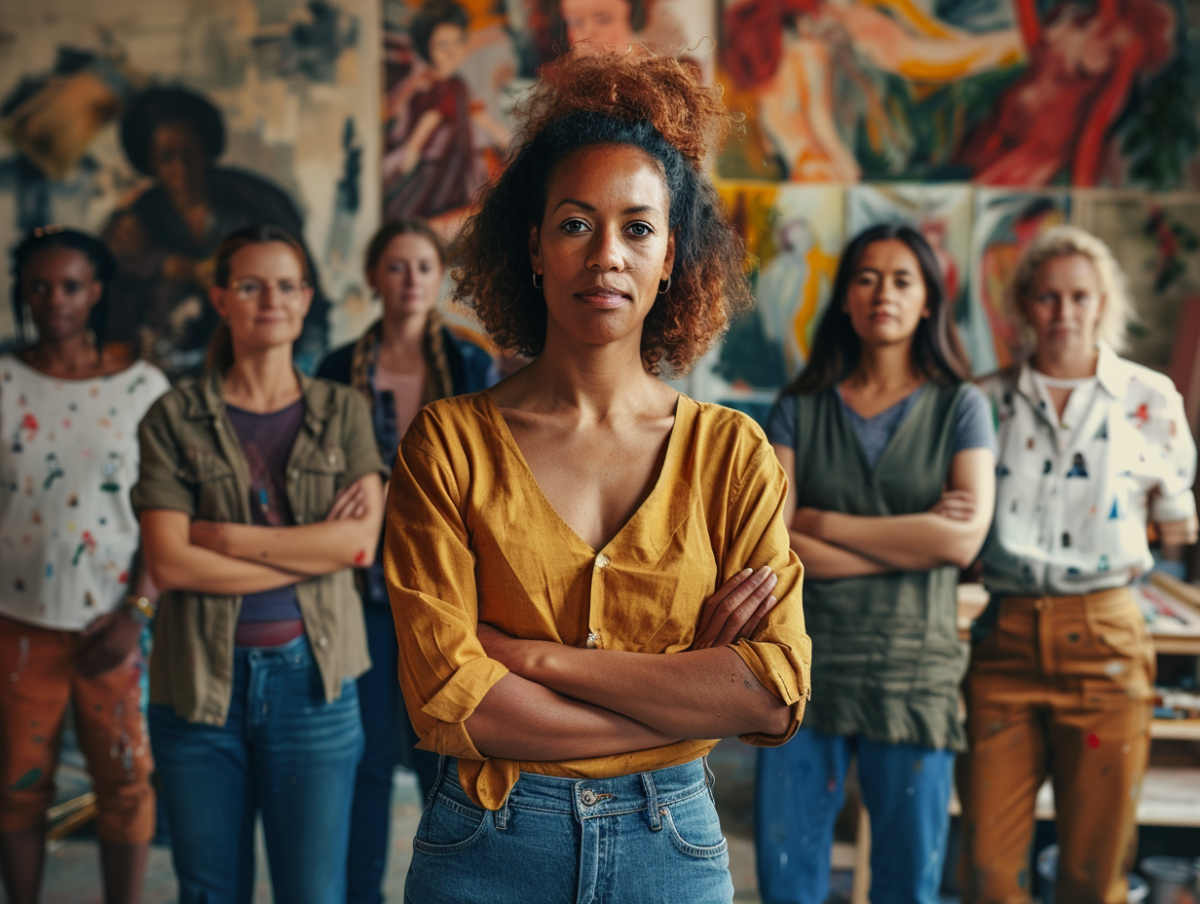
Throughout the ages, women have often been the muses of art, but their own creative contributions have long been minimized or overlooked. Their indelible impact on the history of art is undeniable. From Renaissance painters like Artemisia Gentileschi, who broke the conventions of her time, to avant-garde figures such as Frida Kahlo and Georgia O’Keeffe, these women artists paved the way for new forms of expression. They overcame considerable obstacles to assert themselves in a male-dominated field, thereby inspiring future generations to push the boundaries of art.
Pioneers of Art: Lives of Struggle and Creation
Elisabeth Vigée Le Brun, born in 1755 and passed away in 1842, embodies the iconic figure of the quintessential portraitist. Recognized in her lifetime as one of the greatest portraitists, she crossed the threshold of Gabriel Briard’s studio in the heart of the Palais du Louvre. Her talent and her closeness to Marie Antoinette earned her exceptional admission to the Royal Academy of Painting, making her a model of success in the male-dominated circle of art history.
Frida Kahlo, a painter born in 1907 and died in 1954, stands out for her unclassifiable style and a life marked by resilience. Stricken by polio and later by a tragic accident, she transformed her suffering into powerful works of art, reflecting pain but also female emancipation. Her relationship with Diego Rivera, both a source of inspiration and torment, enriches her artistic approach with a rare intensity.
The 20th century sees the emergence of an artist like Niki de Saint Phalle, whose works challenge traditional expectations. Born in 1930 and passed away in 2002, this visual artist revolutionized the artistic medium with her performances ‘Les tableaux-tirs’, defying conventions. Her colorful sculptures, influenced by figures like Gaudi or Pollock, occupy public space, much like the famous Igor Stravinski Fountain, thus anchoring her legacy in the daily lives of citizens.
In the wake of these pioneers, the name of Muriel Belmondo resonates, illustrating the perseverance and late recognition of certain artists. Among them, Artemisia Gentileschi (1593-1652), a Baroque painter whose life was marked by personal drama and the struggle for recognition of her art. Initiated by Orazio Gentileschi, her father, she was the first woman to be accepted into the Academy of Drawing in Florence. Her work, imbued with an autobiographical dimension and expressive power, reflects a life where artistic creation served as a means to transcend trials and secure a place in the history of art.
Contemporary Legacy: How Women Artists Shape Modern Art
Continuing the legacy of the iconic figures of painting, photographer Cindy Sherman, born in 1954, stands as an icon of reflection on identity and self-representation. Known for her series of self-portraits, Sherman uses photography to deconstruct female stereotypes and question social roles in postmodern society. Her artistic approach, closely linked to the critique of images conveyed by the media and popular culture, challenges conventions and opens up possibilities for contemporary artistic expression.
The engaged artist questioning identity finds its echo in the work of many contemporaries, who exploit various mediums to reveal, interrogate, and sometimes disrupt norms. Sculpture, painting, performance, and video become fields of exploration and manifestation of the diversity of experiences lived by women in the art world.
The transition from the 20th to the 21st century marks a profound evolution in the visibility of these women artists, with a growing interest from institutions and the art market in their works. Dedicated exhibitions, retrospectives, and acquisitions by major museums testify to an increased recognition, although parity remains a goal to be achieved.
Contemporary women artists thus continue the path laid out by their predecessors, enriching the global artistic heritage with their unique vision and ever-renewed creativity. They influence new generations and contribute to redefining the paradigms of modern art, making art not only a mirror of society but also a vector for change.