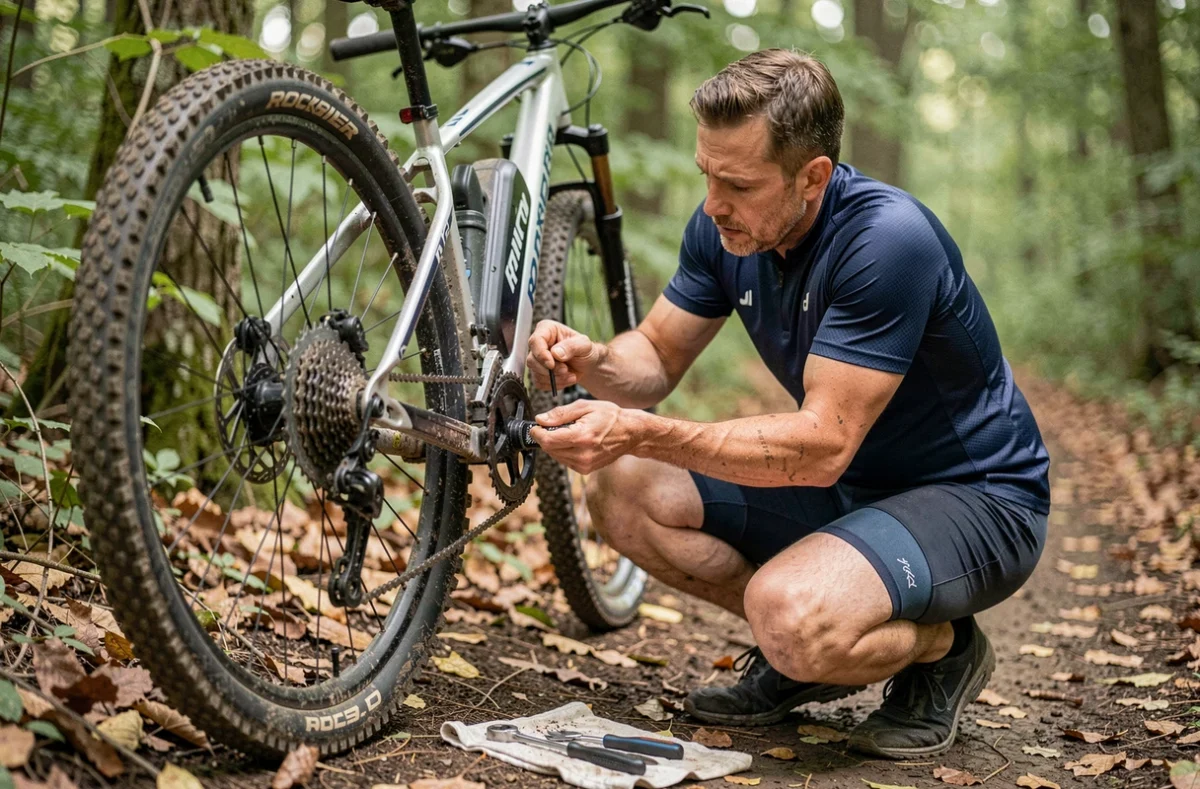
The Rockrider E-ST 100 cuts out after about twenty minutes of pedaling, then starts working again as if nothing happened. This scenario comes up often in user feedback, and it doesn’t necessarily mean the motor is faulty. Before taking anything apart, it’s worth understanding what the bike is trying to tell you—and, above all, what to look for to make the right diagnosis.
Assistance cuts out after a long ride: fault or thermal protection?
You’ve been riding for a while, the motor is working steadily on a climb or a difficult trail, and the assistance suddenly cuts out. A few minutes after stopping, everything works again. This may look like a fault, but it’s often the controller’s thermal protection kicking in.
The E-ST 100’s hub motor heats up when it works under a heavy load for a long time. The electronic controller monitors its temperature. When it exceeds a certain threshold, the controller cuts the power to prevent damage to the components. Once the system has cooled down, the assistance comes back.
This isn’t a manufacturing defect. It’s normal behavior under certain conditions: high outdoor temperatures, long climbs, or tire pressure that’s too low, increasing rolling resistance. Before calling it a Rockrider E-ST 100 fault, note the exact circumstances in which the assistance cuts out: ride duration, elevation gain, ambient temperature, and remaining battery level.
If it also cuts out when the bike is cold, on flat ground, after just a few minutes, the problem lies elsewhere. This distinction makes all the difference when diagnosing the issue.
Connectors and pedal-assist sensor: the two easiest things to check
Before assuming the motor has burned out or the battery is at the end of its life, two things are worth checking first. They’re responsible for many of the assistance issues on this model.
Connectors on the handlebar and frame
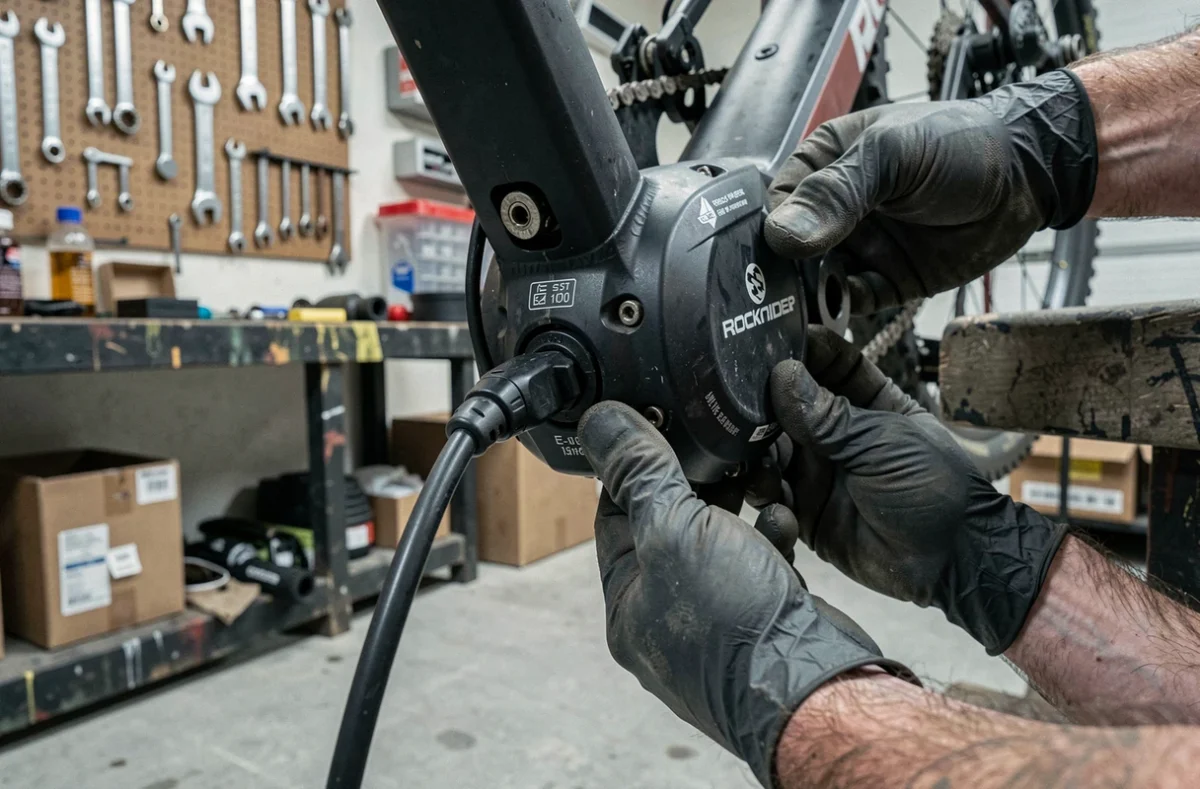
The E-ST 100 uses plug-in connectors between the display (the control screen), controller, and battery. Vibrations on trails can cause a connector to come slightly loose. The assistance may then become intermittent or stop altogether.
Check each connector by unplugging it and plugging it back in firmly. A connector that’s just two millimeters short of being fully seated can be enough to cut out the system. Also inspect the pins: dried mud or moisture inside the connector can cause a poor connection.
The pedal-assist sensor (PAS)
The pedal-assist sensor detects when you turn the pedals. Without this signal, the controller assumes you aren’t pedaling and cuts the assistance. The sensor consists of a magnetic disc attached near the crankset and a small detector.
- Check that the magnetic disc hasn’t shifted on its axle: it should remain aligned with the detector, with a gap of a few millimeters
- Clean the area around the sensor, as metal debris stuck to the magnets can interfere with the reading
- Check whether the pedaling icon appears on the screen when you turn the pedals by hand: if nothing appears, the PAS sensor is probably causing the problem
Rockrider E-ST 100 battery issues: charging and range
The battery is another source of common problems. Two situations come up regularly.
The battery no longer charges fully
You plug in the charger, the light quickly turns green, but the bike’s range remains low. Start by checking that the charger itself works. Plug it into a power outlet on its own: an indicator light should come on. Then connect it to the battery and check whether the light changes color, indicating that charging is underway.
Storing the battery while discharged for several weeks can damage its cells. If the bike won’t be used for a while, keep the charge at around half. Very low temperatures (such as an uninsulated garage in winter) can also temporarily reduce capacity.
The battery drains quickly during use
Before suspecting a worn-out battery, check the tire pressure. Decathlon support recommends a pressure of between 1.0 and 1.8 bar for the original inner-tube setup. Underinflated tires increase rolling resistance and force the motor to use more energy. As a result, the range drops noticeably.
The assistance mode you use also matters. Riding in the most powerful mode all the time cuts the range compared with using Eco mode. Switching modes to suit the terrain is the most direct way to get a satisfactory range again.
When to take the bike to a Decathlon workshop: what to note beforehand
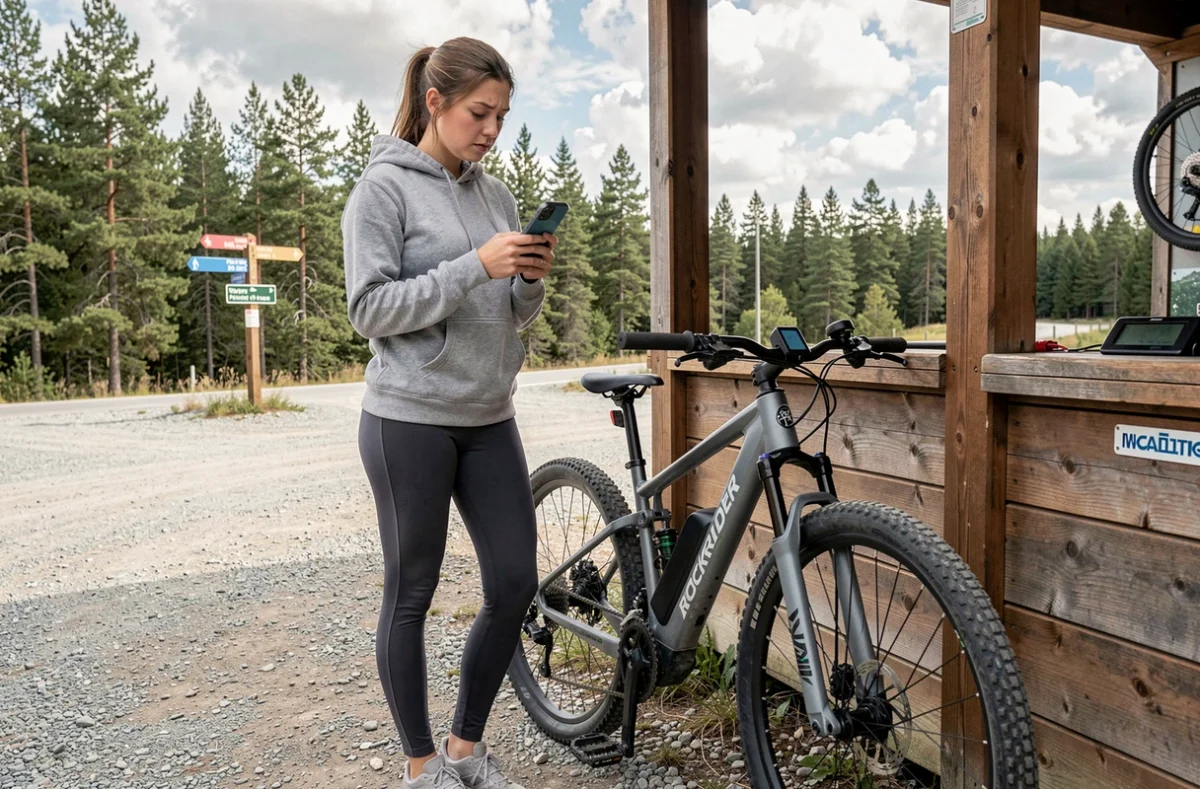
You’ve checked the connectors, pedal-assist sensor, tire pressure, and battery behavior, but the problem persists. It’s time to take the bike to a workshop. To help the technician save time, bring along some useful information.
Make a note of the following before your visit:
- How the assistance cuts out: suddenly (everything switches off) or gradually (the assistance weakens before disappearing)
- When it happens: when the bike is cold, after a specific amount of time, on a climb, or on flat ground
- What the display does: whether it shows an error code, stays on when the assistance cuts out, or switches off too
- Recent riding and storage conditions: prolonged storage, riding in the rain, or an impact to the rear wheel
These details help the technician distinguish between a controller, hub motor, or battery issue without guesswork. An accurate diagnosis depends on what you observe while riding, not just on a test in the workshop.
If the bike is still under warranty, keep your proof of purchase. Decathlon support covers manufacturing defects in electrical components. However, wear caused by improper battery storage or insufficient tire pressure isn’t covered by the warranty.
Most assistance cutouts on the E-ST 100 can be fixed without replacing an expensive part. Reseating a connector, realigning a sensor, or inflating the tires to the correct pressure is often enough to restore normal operation. The key is not to mistake the system’s protective response for an actual fault.